
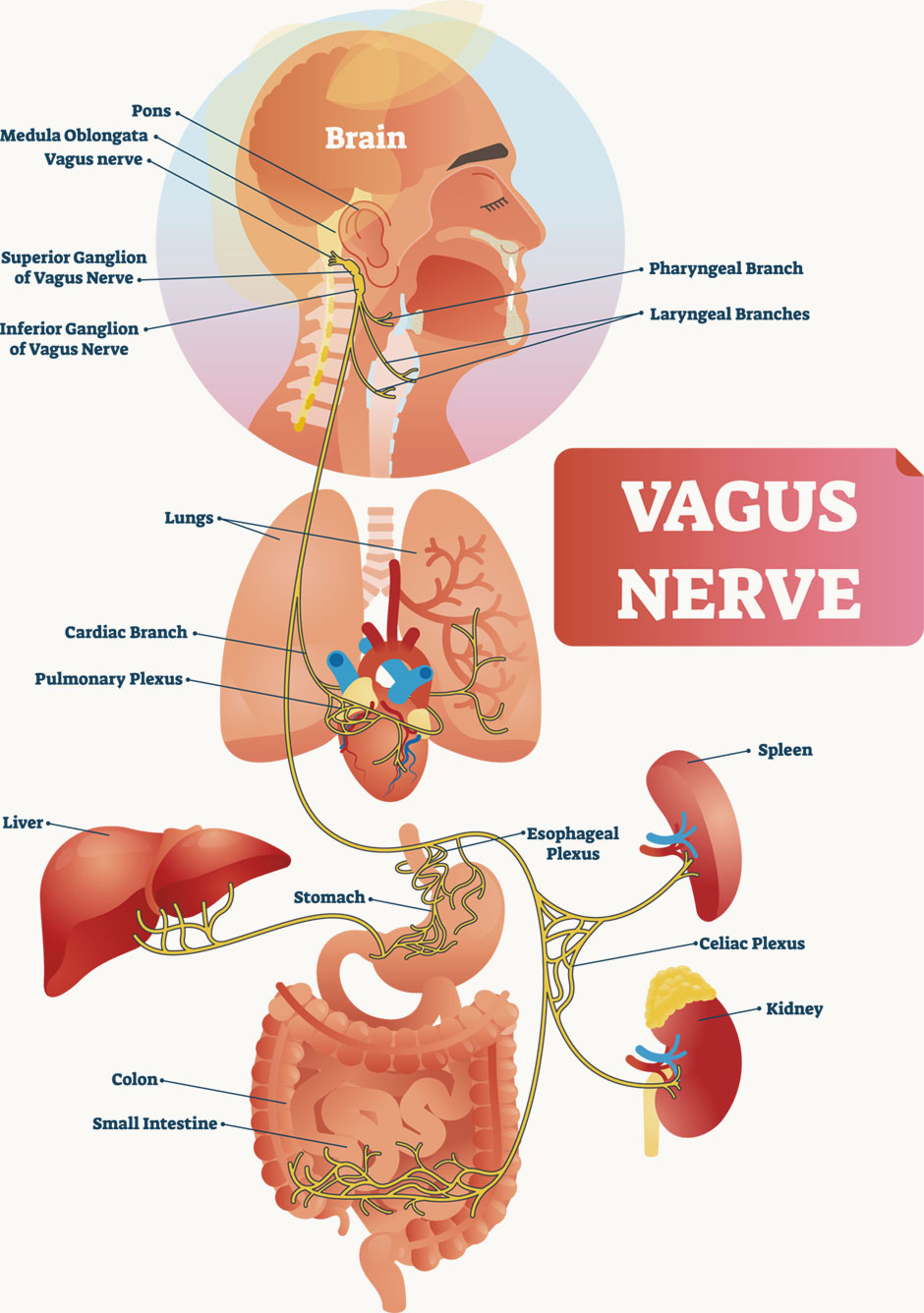
Research on vagus nerve stimulation, VNS, has been intensive in recent years and has mostly concerned electrical VNS. A number of papers have been published, some of which are briefly described below.
VNS and the heart
A review article from 2023 focused on VNS and inflammation in cardiovascular disease. The authors found that VNS appears to reduce inflammation during both a heart attack and the phase when oxygenated blood returns to the heart muscle cells (the reperfusion phase). They note that VNS reduces infarct size and the incidence of irregular heart rhythms during the reperfusion phase. They also stated that VNS appears to protect the heart after the myocardial infarction and reperfusion, with, among other things, a reduced incidence of atrial fibrillation.av förmaksflimmer.
Bazoukis G, Stavrakis S, Armoundas AA. Vagus Nerve Stimulation and Inflammation in Cardiovascular Disease: A State-of-the-Art Review. J Am Heart Assoc. 2023 Oct 3;12(19):e030539. doi: 10.1161/JAHA.123.030539. Epub 2023 Sep 18. PMID: 37721168; PMCID: PMC10727239.
FDA-approved clinical uses for VNS
This 2022 article summarized the conditions for which the FDA (U.S. Food and Drug Administration) approved the use of various types of VNS, which at the time were epilepsy, depression, migraine, cluster headache, pain conditions, and obesity. They further described the studies in both animal models and patients that formed the basis for the FDA’s approval for each disease. The types of VNS in the article included implanted electrical VNS on the neck, VNS at the ear where electrical impulses are sent through needles that are inserted through the skin to the part of the vagus nerve that runs here, and VNS locally in the abdomen.
Goggins E, Mitani S, Tanaka S. Clinical perspectives on vagus nerve stimulation: present and future. Clin Sci (Lond). 2022 May 13;136(9):695-709. doi: 10.1042/CS20210507. PMID: 35536161; PMCID: PMC9093220.
Neuromodulation in anxiety and depression
This article published last year summarized the studies on animal models and patients with anxiety and depression done with different types of neuromodulation, including electrical VNS on the neck. The authors concluded that VNS affects many areas of the brain involved in depression and also the neurotransmitters involved in the disease mechanisms (including serotonin). Furthermore, they referred to an article in which approximately half of patients with recurrent depression treated with VNS were still in remission after two years.
Guo B, Zhang M, Hao W, Wang Y, Zhang T, Liu C. Neuroinflammation mechanisms of neuromodulation therapies for anxiety and depression. Transl Psychiatry. 2023 Jan 9;13(1):5. doi: 10.1038/s41398-022-02297-y. PMID: 36624089; PMCID: PMC9829236.
VNS for neurological diseases
A review article from 2021 summarized the most important studies on VNS in connection with neurological diseases conducted on animals and humans. In addition to epilepsy, depression and headache disorders, the results of VNS in Parkinson’s disease, autism spectrum disorder, traumatic brain injury and stroke were described. Their conclusion was that the studies carried out so far showed promising results in the majority of these conditions. The favorable results of VNS in neurological disease were described, among other things, as due to an anti-inflammatory effect and improved function of the blood-brain barrier. However, they emphasized that more studies of higher quality are needed regarding several of these conditions to better understand whether and how VNS can be an appropriate treatment.
Wang Y, Zhan G, Cai Z, Jiao B, Zhao Y, Li S, Luo A. Vagus nerve stimulation in brain diseases: Therapeutic applications and biological mechanisms. Neurosci Biobehav Rev. 2021 Aug;127:37-53. doi: 10.1016/j.neubiorev.2021.04.018. Epub 2021 Apr 21. PMID: 33894241.